B2B (business-to-business) marketing is the set of strategies a company uses to attract, educate, and convert other companies into customers. In technology companies, it has a unique aspect: the buyer isn’t a single person, but rather a group of people with different interests, who conduct their own research for weeks before speaking with a salesperson and make decisions based on return on investment, risk, and trust.
This significantly changes the nature of marketing work. It’s not enough to simply generate a high volume of leads or create eye-catching ads. The role of B2B marketing in a technology company is to be present—with useful information—throughout the entire research process, so that the brand is already the go-to choice when the buyer decides to reach out to someone.
In this article, you’ll learn what sets B2B marketing apart from B2C marketing, how to build authority in the tech industry, what pillars underpin a strategy that generates real demand, where artificial intelligence fits into this, and which metrics show whether your investment is paying off.
The New Landscape of B2B Marketing in the Technology Sector
A large, fast-growing market
The technology sector is one of the driving forces behind the Brazilian economy. According to the 2025 Sector Report by Brasscom, the association of information and communication technology companies, the ICT macro-sector generated R$ 919.7 billion in 2025, equivalent to 7.2% of Brazil’s GDP, representing a 15% increase over the previous year.
A growing market means more competition. For a software company, SaaS (software sold as a service, usually on a subscription basis), or technology services provider, having a good product is no longer enough to stand out. The competition is increasingly taking place before the sale: in capturing the attention and trust of those doing their research.
B2B buyers have changed their behavior
Today's technology buyers prefer to handle as much as possible on their own. A Gartner survey published in March 2026 showed that 67% of B2B buyers prefer a salesperson-free buying experience, and 45% have used artificial intelligence in a recent purchase.
The amount of time spent in direct contact with suppliers is also limited. Gartner studies on the B2B buying journey indicate that buyers spend only about 17% of their time during the buying process talking to suppliers, and that time is further divided among all the competitors being evaluated. The rest is spent on independent research and internal alignment.
And these buyers have little patience for generic approaches. In another Gartner survey, 73% of B2B buyers said they actively avoid suppliers who send irrelevant messages.
The Structural Challenges of Selling Technology to Businesses
Three characteristics make B2B technology marketing more complex than marketing in other sectors:
Long sales cycles: months can pass between the initial research and the signing of the contract. And this timeframe is increasing: reports from Ebsta, in partnership with Pavilion, show that B2B sales cycles became about 16% longer between 2022 and 2024.
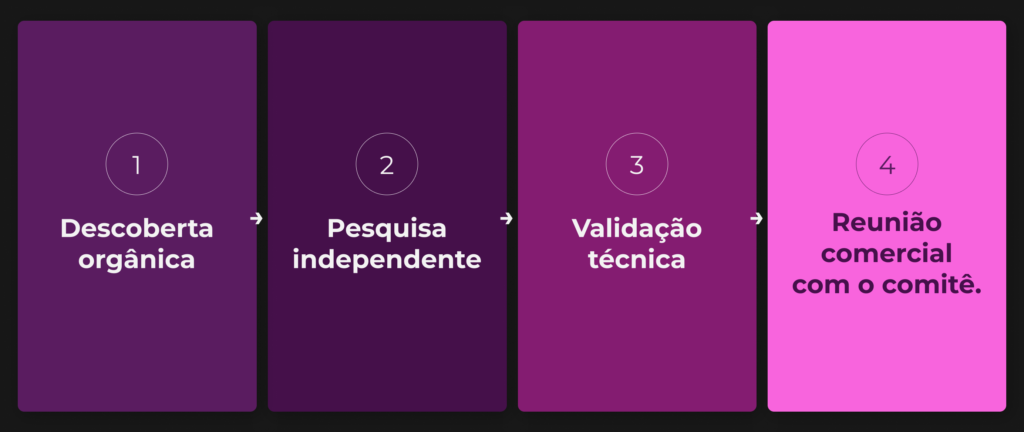
Purchasing committee: A technology solution affects several areas at once, which is why the decision typically involves six to ten people, according to Gartner. Each person has a specific concern: the IT director focuses on security and integration, the finance director on cost and return on investment, and the end user on ease of use.
High stakes and perceived risk: High-value contracts—involving implementation, training, and system migration—mean that mistakes can be costly. That’s why buyers do more research, compare more options, and need more evidence before making a decision.
B2B marketing is no longer a cost center
Given this scenario, the role of marketing has changed. Instead of simply promoting the brand and providing leads to the sales team, modern B2B marketing takes on a consultative role: it helps the buyer understand their own problem, compare alternatives, and build an internal case for the purchase. When done well, the sales meeting begins on a whole new level, with a client who already trusts the company.
B2B vs. B2C Marketing for Tech Companies: The Rules Are Different
Why B2C Tactics Waste the Budget in B2B
It’s common to see tech companies applying B2B strategies that work for selling to end consumers: impulse-driven ads, flash sales, and click-volume optimization. The result is often a funnel full of leads who never make a purchase. We discuss this in detail in our article on why many Google Ads accounts generate clicks but not customers.
The difference lies in the nature of the decision. In B2C, an individual makes the decision—often quickly and with emotional weight. In B2B, a group makes the decision, based on return on investment, operational efficiency, and technical evaluation. Emotion also plays a role in B2B (no one wants to be held responsible for a bad purchase), but it manifests as a search for certainty, not as an impulse.
| Criterion | B2B Marketing (Technology) | B2C Marketing |
| The Complexity of the Journey | Onboarding, involving several stages of research, technical evaluation, and internal approval | It lowers the average, often resolved in a single session |
| Decision-makers involved | Purchasing committee, typically consisting of 6 to 10 people | A person, sometimes a family |
| Sales Cycle | Weeks to months | Minutes to days |
| Average ticket price | High, with recurring contracts | Low to medium, occasional purchases |
| Content Format | Guides, comparisons, case studies, webinars, demos, ROI calculators | Short videos, influencers, offers, reviews |
| Key KPIs | Opportunities generated, pipeline in R$, CAC, LTV, revenue | Sales, average order value, ROAS, repeat purchases |
Chet Holmes' Buyer's Pyramid
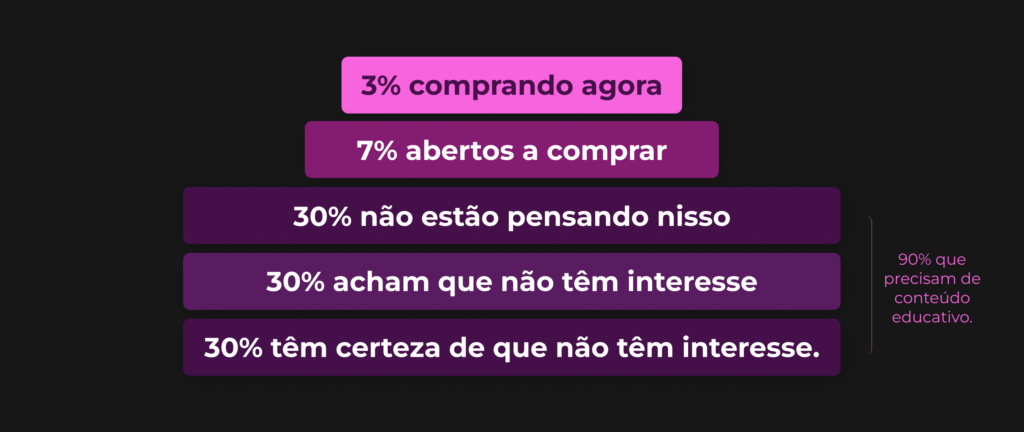
One of the most instructive ways to understand why B2B requires patience comes from Chet Holmes, author of the book *The Ultimate Sales Machine*. He proposed what is known as the Buyer’s Pyramid: in any market, at any given time, only about 3% of potential customers are buying right now, and another 7% are open to buying. The remaining 90% are divided into three groups of 30%: those who aren’t thinking about it, those who think they aren’t interested, and those who are certain they aren’t interested.
Based on this, Holmes developed the concept of the “Stadium Pitch”: imagine that your entire market is seated in a stadium and you have the microphone. If you start by talking about your product, only 3% will pay attention. If you begin with information that helps everyone understand an industry problem, you’ll keep the entire stadium listening—and plant your brand in the minds of those who will buy from you later on.
The figures in the pyramid are a rule of thumb, not the result of a survey. But the logic has been confirmed by more recent studies. In a study conducted by Professor John Dawes of the Ehrenberg-Bass Institute in collaboration with LinkedIn’s B2B Institute, the conclusion was that only about 5% of B2B buyers are actively in the market at any given time. The other 95% won’t make a purchase for months or years, and the task of marketing is to ensure that, when that time comes, they remember your brand.
B2B tech vs. B2C tech: two sales models
Even within the tech sector, there are two very different models. In B2C tech—such as consumer apps—sales are direct, mass-market, and almost always salesperson-free: people download, try out, and sign up. In B2B tech, especially in corporate sales (the so-called enterprise market, which consists of large companies), sales involve committees, customized solutions, contract negotiations, and implementation.
There are also intermediate models, such as PLG (product-led growth), in which the product itself—through free trials or entry-level plans—is part of the acquisition process. Even in these cases, when the contract expands and begins to involve more areas of the client company, the B2B model once again applies.
How to Build Authority in the Technology Market
What Is Authority, in Practice?
Authority is what makes a client arrive at a sales meeting already inclined to close the deal. It’s the combination of the perception that your company understands the problem better than the alternatives, has already solved it for similar companies, and is a safe choice. In a market where buyers do their own research and avoid salespeople, authority is what makes your brand stand out—and be taken seriously—during that research.
The 4 Pillars of B2B Authority
1. A clear and defensible positioning: No company is a leader in everything. Authority begins with choosing a specific problem and a niche in which the company wants to be the first name that comes to mind. “Business management software” doesn’t set anyone apart. “ERP for glass and metal fabrication shops,” on the other hand, does.
2. Content that educates before selling: guides, comparisons, frameworks, and technical articles that address buyers’ real questions, without asking for anything in return right away. It’s the “Stadium Pitch” applied to everyday life: useful content for the entire stadium, not just the 3%.
3. Consistent presence on the right channels: In the B2B tech sector, depth matters more than being everywhere. The channels that most often establish authority are LinkedIn (for the company and, especially, its leaders), a blog with an SEO strategy, and a proprietary newsletter, which creates a direct channel without relying on algorithms.
4. Case studies and social proof: testimonials, before-and-after statistics, and real customer stories reduce perceived risk at every stage of the sales funnel, not just at the closing stage. A good case study answers the question every purchasing committee asks: “Has this worked for someone like us?”
H2H Communication: Decisions Are Made by People
Even in highly complex corporate negotiations, it is people who make the decisions. That is why the concept of H2H (human-to-human) has gained traction: a form of communication that treats the buyer as someone with real pressures, deadlines, and fears—not as a line item on a spreadsheet. In practice, this means using clear language instead of jargon, being transparent about what the solution does and doesn’t do, and showing empathy for the context of the person on the other end.
Checklist: Building B2B Thought Leadership in 4 Steps
- Define your target market: For which specific problem and for what type of company does your brand want to be the first one that comes to mind?
- Map out the buyer’s questions: What does the purchasing committee research before speaking with a salesperson? Each question is a content topic.
- Choose just a few channels and be consistent: it's better to post every week on two channels than occasionally on five.
- Turn results into evidence: document case studies with numbers, obtain testimonials, and feature this evidence on your website, in your ads, and in sales conversations.
High-Impact Strategic Pillars for Technology Companies
A) Inbound marketing and technical content
Inbound marketing is a strategy for attracting potential customers with relevant content, rather than interrupting them with cold approaches. In technology companies, content must have sufficient technical depth to convince those who understand the subject: long, in-depth articles; white papers (technical documents about a problem and its solution); comparative e-books; recorded demos; and webinars.
The key point is that each piece of content should speak to a different member of the purchasing committee and address a different stage of the journey. The same product may require an article on information security for the IT team, a ROI calculator for the finance team, and a tutorial for the end user. We explore this concept in more depth in our content on personalization in the B2B buying journey.
B) Account-Based Marketing (ABM)
ABM (account-based marketing) flips the traditional approach on its head. Instead of attracting a large number of leads and filtering out the best ones, the company first selects a list of high-value accounts (usually large, enterprise-level companies) and creates personalized campaigns for each one or for small groups.
In practice, ABM combines tailored content, ads targeted at employees of that company, and coordinated efforts between marketing and sales. It requires more effort per account, which is why it makes the most sense when the value of the deal justifies it: large, recurring, and strategic contracts.
C) The New Era of Search: SEO, GEO, and AEO
SEO (search engine optimization) remains the foundation: optimizing the website and its content to rank highly on Google when a buyer searches for a problem or a solution.
But the way people search has changed. As we’ve seen, nearly half of B2B buyers already use AI during a purchase. That’s why GEO (generative engine optimization) has emerged—which involves optimizing content so it can be found, understood, and cited by AI tools such as ChatGPT, Gemini, and Perplexity. You’ll also come across the acronyms AEO (answer engine optimization) and AIO (artificial intelligence optimization), which describe very similar concepts: structuring content so that it answers questions clearly, with verifiable data and reliable sources.
We explain the concept in the article “What Is GEO and Why It Matters to Your Software Company Now,” and we’ve compiled a checklist of practical steps to help you appear in the recommendations from ChatGPT, Perplexity, and Gemini.
D) Strategic paid media: Google, LinkedIn, and Meta
Paid media in B2B works best when each platform fulfills a specific role:
Google Ads (Search Network) captures existing demand: someone is actively searching for a specific type of solution, and the ad appears at that very moment. It’s the channel closest to the 3% who are buying right now.
LinkedIn Ads lets you reach decision-makers based on their job title, industry, and company size. The Matched Audiences feature goes a step further: it allows you to target specific lists of companies or contacts (very useful for ABM) and people who have already visited your website.
Meta Ads (Facebook and Instagram) are often used in B2B as a lead nurturing and remarketing channel. With Custom Audiences, you can retarget website visitors or contacts in your database at a cost that’s generally lower than that of LinkedIn.
What unites these three is the right metric: B2B campaigns should be optimized for opportunities and revenue, not just for clicks or form submissions. We show you how to set up this framework in the article “From Structure to Creative: How to Create a Paid Media Plan That Actually Converts.”
E) Marketing + Sales + Customer Success
Smarketing is the term used to describe the alignment between marketing and sales. In practice, it means that both teams work with the same ICP (Ideal Customer Profile), the same definitions of a qualified lead, and an SLA (service level agreement) that specifies what each side delivers and within what timeframe. We go into detail about this alignment—and the metrics involved—in our content on B2B sales and revenue predictability.
The cycle doesn’t end with the sale. Customer success (the department responsible for customer success) ensures that the customer achieves results with the solution, which reduces churn (cancellations) and increases LTV (lifetime value—the value a customer generates over the course of the entire relationship). In the B2B technology sector, this customer base is a key source of growth: the 2025 report by Ebsta in partnership with Pavilion showed that 52% of the new revenue generated by the companies analyzed came from customers who were already part of their customer base.
Reference Matrix: How Budget Allocation Typically Evolves
A reference model for discussion, not a market benchmark. The ideal distribution depends on the ticket size, the sales cycle, and the maturity of each company.
| Channel | Initial phase | Growth | Maturity |
| Paid media from search (Google Search) | Paid traffic: generates quick demand while organic traffic doesn't exist | Average | Medium to low |
| Content and SEO/GEO | Lower the average: start building the foundation | Upswing: Begins to Generate Its Own Demand | Alta: the primary source of authority |
| LinkedIn Ads and ABM | Write-off: only for highly strategic accounts | Average | High, if the focus is on the enterprise |
| Remarketing and Lead Nurturing (Meta, Email) | Checkout | Average | Average |
| Customer Success and Expansion | Checkout | Average | High: Base Becomes a Source of Revenue |
Case Montre: Dígitro

Dígitro develops communication, intelligence, and corporate security technology and already had a strong marketing team. Montre came on board as a performance and strategic content partner.
Result: +185% in MQLs (marketing-qualified leads), at a cost that was 18% lower.
Check out this and other case studies from Montre →
Artificial Intelligence in B2B Marketing: From Automation to Personalization
The Impact of AI on Results
Artificial intelligence is no longer just an experiment in B2B marketing. A McKinsey analysis of AI in marketing and sales found that companies investing in AI reported revenue increases of 3% to 15% and a 10% to 20% improvement in return on investment in sales. It’s worth noting, however, that these are companies that were already investing in AI in a structured way, and the gains depend on how the technology is applied.
Practical Applications of AI in B2B
Sales Forecasting and Business Intelligence
AI models analyze sales history, lead behavior, and market signals to anticipate trends and estimate results more accurately than manual spreadsheets.
Qualification and Lead Scoring
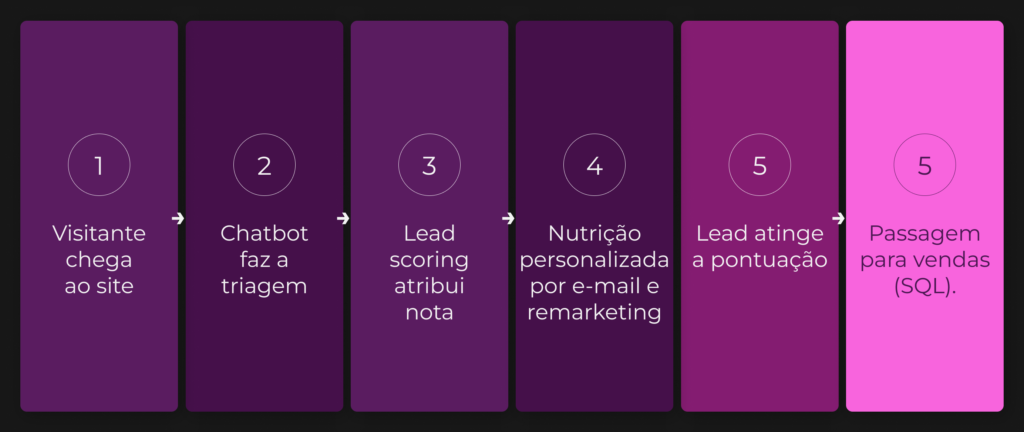
Chatbots perform an initial screening of website visitors, answer common questions, and forward the right leads to the sales team. Lead scoring, on the other hand, assigns a score to each lead based on their profile and behavior, so that the sales team can prioritize those most likely to make a purchase.
Customization at Scale
AI makes it possible to automatically segment campaigns, tailor messages based on each contact's stage in the customer journey, and adjust remarketing based on what the lead has already viewed or done.
AI as an enhancer, not a replacement
AI speeds up processes, organizes data, and helps structure ideas. But true authority depends on something it cannot produce on its own: real-world experience, a unique perspective, and accountability for what is said. Buyers themselves point this out. A Gartner survey released in May 2026 showed that 69% of B2B buyers prefer to verify with a salesperson the information they received from AI tools. In other words, AI has expanded access to information, but it has also increased the value of those who can interpret it based on experience.
Essential Metrics and KPIs for Measuring True Success
Avoid vanity metrics
Clicks, impressions, likes, and followers are easy to measure and look good in reports, but they say little about the business. These are what are known as vanity metrics. In B2B marketing, what matters is how much marketing contributes to generating real opportunities and revenue. That’s why the key indicators are the pipeline generated in reais (the total value of sales opportunities that marketing helped create) and ROI (return on investment). We explain why this shift in focus is so important in the article “MQL Is Not Pipeline.”
Key Metrics in B2B Marketing
MQL (Marketing Qualified Lead). A lead that the marketing team considers to match the ideal customer profile and be ready for a sales approach.
SQL (Sales Qualified Lead). A lead that the sales team has reviewed and accepted as a genuine opportunity.
CAC (Customer Acquisition Cost). The amount a company spends on marketing and sales to acquire each new customer. The basic calculation is the sum of marketing and sales investments for the period, divided by the number of customers acquired.
LTV (Lifetime Value). The amount of revenue (or margin) a customer generates over the entire time they remain with the company. A widely accepted benchmark in the SaaS market is that LTV should be at least three times the CAC: if it’s lower than that, the company tends to spend too much to acquire customers who don’t pay for themselves.
Conversion rate by channel. How many leads from each channel (organic, paid media, LinkedIn, referrals) turned into opportunities and customers. This shows where it’s worth investing more.
Retention and churn rates. How many customers stay and how many cancel over a given period. In subscription models, high churn can negate all acquisition efforts.
B2B Marketing KPIs
| KPI | How to calculate | What it reveals | Reference |
| Pipeline generated (R$) | Total value of opportunities generated or influenced by marketing | Marketing's Actual Contribution to Sales | Compare with the revenue target and historical data |
| MQL to SQL Conversion Rate | SQLs vs. MQLs for the period | Lead quality and alignment with sales | Keep an eye on the trend; drops indicate ICP misalignment |
| Win rate | Opportunities won ÷ opportunities closed | Closing Efficiency | 19% of new customers (Ebsta & Pavilion, 2025) |
| CAC | Marketing and sales investment ÷ new customers | Cost per customer acquired | Always evaluate this in conjunction with the LTV |
| LTV:CAC | LTV ÷ CAC | Sustainability of the acquisition | Market benchmark: 3:1 or higher |
| Churn | Customers lost ÷ customers at the beginning of the period | Retention and Workforce Health | The lower, the better; compare by segment |
| Marketing ROI | (Revenue allocated − investment) ÷ investment | Total Return on Investment | It depends on the sales cycle; evaluate over long periods of time |
Recommended technology stack
A stack is the set of tools that supports operations. There is no one-size-fits-all stack for every company, but these are the essential categories and some of the most commonly used tools in each:
| Category | What is it for? | Examples of tools |
| CRM | Record accounts, contacts, opportunities, and sales history | RD Station CRM, HubSpot, Zoho CRM |
| Marketing automation | Lead nurturing, email marketing, lead scoring, and automated workflows | RD Station Marketing, HubSpot Marketing Hub |
| Analytics | Measuring traffic, conversions, and customer sources | Google Analytics 4, Looker Studio |
| SEO | Monitor rankings, keywords, and the technical health of the website | Google Search Console, SEMrush, Ahrefs |
| Paid media | Create, manage, and optimize campaigns | Google Ads, LinkedIn Campaign Manager, Meta Ads Manager |
| ABM | Identify accounts, orchestrate campaigns, and measure engagement by company | Maestro ABM, HubSpot ABM features |
| Content and AI | Research, production support, and editorial organization | Generative AI assistants, editorial management tools |
Frequently Asked Questions
It is marketing conducted by a company to sell to other companies. Unlike marketing to end consumers, it involves group decision-making, longer sales cycles, and higher transaction values, and therefore relies more on educational content, authority, and alignment with the sales team.
It depends on the strategy. Paid media can generate opportunities in the first few weeks. Organic strategies, such as SEO and content, take longer: Google itself estimates, in its guide on hiring SEO specialists, that it typically takes four months to a year for improvements to start yielding results. In markets with a long sales cycle, the impact on revenue also follows that cycle.
There is no standard amount. The investment varies depending on the company’s digital maturity, the channels chosen, the media volume, and the size of the team—whether in-house or outsourced. A safer approach is to start with the revenue goal and an acceptable CAC, and then calculate how much to invest to reach that goal.
SEO is the process of optimizing content to appear in traditional search engines, such as Google. GEO and AEO are the processes of optimizing content so that it can be found and cited by AI tools, such as ChatGPT, Gemini, and Perplexity. Since a large portion of B2B buyers already use AI for research, ranking well on both fronts has become an integral part of building authority.
The pipeline generated in reais—that is, the value of actual sales opportunities that marketing helped create—along with the ROI. Metrics such as lead volume and clicks are useful for day-to-day operations, but they only make sense when linked to opportunities and revenue.
Conclusion: B2B marketing is an ongoing process
B2B marketing for technology companies isn’t a campaign with a beginning, middle, and end. It’s an ongoing process of building authority, educating the market, and integrating data from marketing, sales, and customer success. Companies that do this well are top of mind when the 5% of the market decides to buy; they enter meetings with greater buyer confidence; and they also grow their existing customer base.
If you want to understand where your marketing efforts are missing opportunities—from positioning to closing deals—Montre offers a free marketing and sales assessment for B2B technology companies. Schedule your assessment and learn about the results we’ve already achieved with other companies in the industry.